What do you do?
The search for an honest sentence.

In one of those painting conversations with a friend, the question came up: What do you do?
It’s an innocent-sounding question, but perhaps it’s the only real question we can ask. I reeled off one of those clever statements that, even a few days later, I’ve forgotten. What I said wasn’t untrue, or even unhelpful, but it was deeply elusive and, as he said, “far too abstract and obtuse.”
I had to agree. I could even feel that familiar slippage into the obscure as the words unfolded from my mouth. It was the kind of sentence that was probably trying too hard to make me sound deep, well-read, and more certain than I really was.
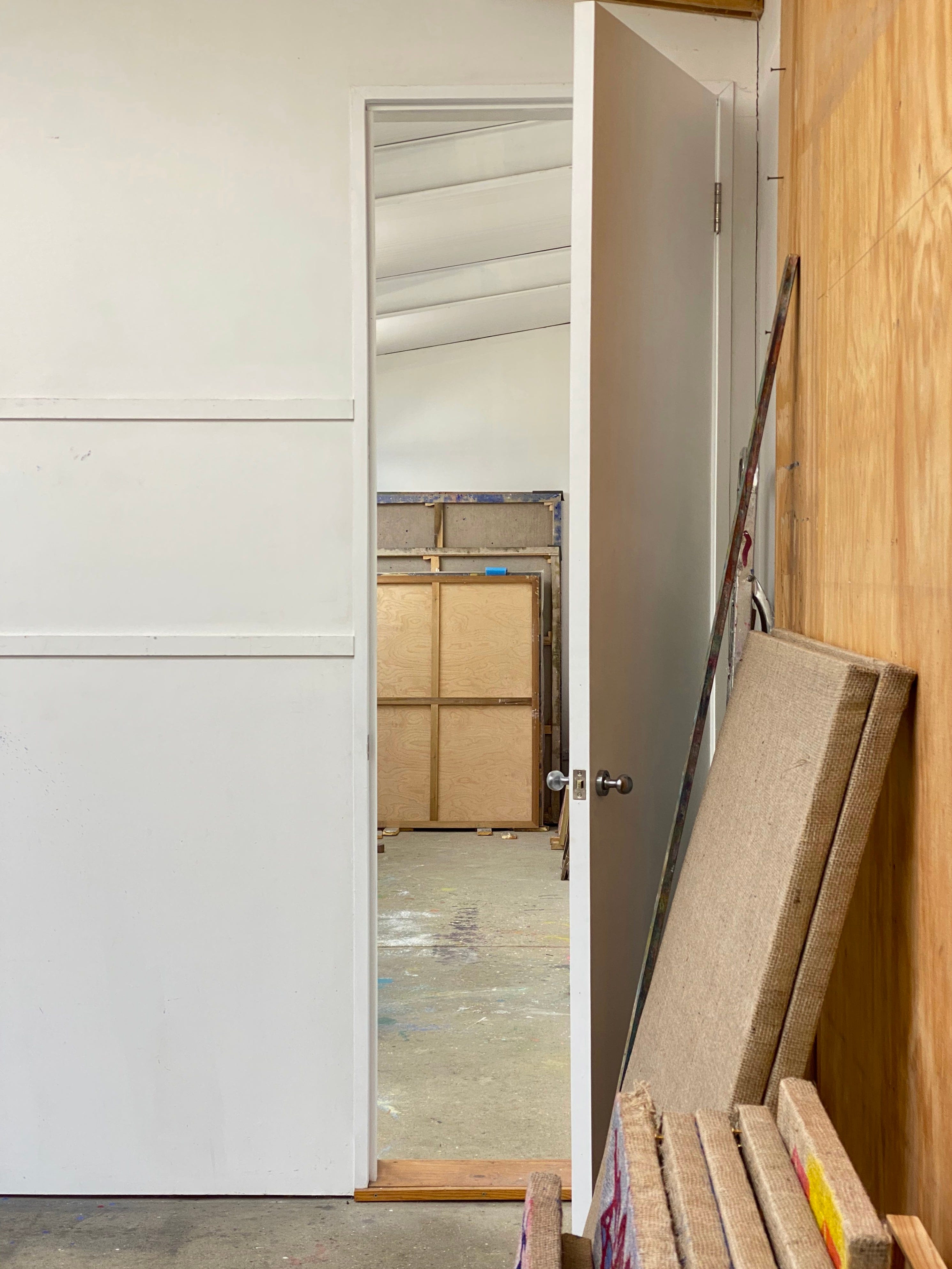
What do I do? I repeated the question a number of times, as though trying to grasp the meaning of something just out of reach. For some artists the answer appears deceptively simple. Morandi painted bottles (mostly), but really he painted relationships. Rembrandt painted portraits of himself dressed up, yet they became studies of identity, performance, and time. Rothko painted blocks of colour stacked above one another, but somehow those blocks became places to stand emotionally. There is a clear sense of what each of them did, a sentence that opens beyond itself into something more complex and resonant with what, who, and where we are.
Our conversation has continued for a number of days as we have tried to make clear what it is we’re really doing. It’s made more difficult because we both make paintings that sit somewhere between abstraction and the observed world. They are, in many ways, a mystery, and that potential is part of their thing. But is mystery what we do? However hard we tried, our answers kept slipping into something too unimaginable, something that immediately required explanation. If the sentence needs another paragraph to survive, perhaps it isn’t the sentence we’re looking for.
We decided there must be some characteristics to this elusive description. It must be easily legible. You should be able to say it to anyone and receive, “That’s interesting, do you have any images?” rather than a politely bemused look. It had to work on anyone, not just the art literate. It couldn’t depend on specialist language or theoretical scaffolding. It needed to carry itself.
This only made the task harder. We found ourselves constantly slipping back into the language we’re most familiar with when talking about painting. We would reach for words like ambiguity, perception, materiality or memory, only to discover they clouded the sentence rather than clarified it.
Just what do we do?
What is it in its simplest terms? At the same time it must remain specific. It must describe what we are doing in a way that is both general and particular. It should open the door to further questions while also being perfectly adequate on its own. It shouldn’t explain everything, only enough that the work can begin to speak for itself.
Perhaps that’s the difficulty. Paintings are rarely made from a single intention. They accumulate. They gather experiences, failed attempts, accidents, decisions, and moments of recognition. By the time they leave the studio they often know more than we do. Trying to compress that process into one sentence can feel like trying to describe a landscape by pointing to a single stone.
After many attempts at finding something that held its ground while still playing lightly enough with the work itself, I realised there were perhaps three different contexts for this sentence. They are less three versions of the same answer than three different uses for it, and I think they’re worth sharing here. They may even help other artists create a little clarity around their own work.
The first is a private rule of studio life.
This seems like the most helpful place to begin. It’s a sentence that describes what you do to yourself before it describes it to anyone else. Private, because sometimes dressing what we do up in words can diminish its potential before it’s had a chance to live for a while and grow. A sentence like this isn’t trying to impress anyone. It’s there to keep you honest. It quietly reminds you what you’re looking for when you’re lost halfway through a painting, when everything feels uncertain and every decision seems equally plausible.
The second is the public description.
This is what you tell someone at a party, your hairdresser, or the stranger who asks what you do. It’s a description that both opens the work up and grounds it. It shouldn’t flatten the paintings into a slogan, but neither should it send the listener searching for a glossary. Ideally, it invites curiosity. It makes someone want to ask another question or, better still, to see the work itself.
The third is the critical context.
This perhaps asks a little more of both speaker and listener. Rather than describing the work in isolation, it places it within a larger contemporary and historical conversation. It acknowledges where the work has come from, what traditions it borrows from or resists, and what questions it shares with other artists. It isn’t necessarily the sentence you begin with, but it may be the one that allows the work to take its place among other works.
I’ve begun to think these three sentences don’t compete with one another. They simply answer different versions of the same question. One keeps the work alive in the studio. One invites others towards it. One situates it within a wider conversation.
The question, What do you do?, still feels impossibly large. Perhaps it always will. But instead of searching for the perfect sentence, I’m beginning to think it’s enough to find the right sentence for the right moment. That feels less like reducing the work and more like allowing it to arrive in different ways, depending on who is asking.
What do you do?
It's such a simple question, yet I find it one of the hardest to answer.
A few days ago, during a conversation with another painter, we found ourselves trying to describe our work in a single sentence. Every answer seemed either too abstract or too reductive. The more we reached for words like ambiguity, materiality or memory, the less clear we became.
It made me wonder whether we were trying to answer the wrong question.
This week's essay explores that conversation and a simple framework that emerged from it. I've come to think that every artist might need three different sentences: one that keeps the work alive in the studio, one that invites others towards it, and one that places it within a wider critical conversation.
Finding those sentences isn't about marketing. It's about clarity. Sometimes the right words don't explain the work, they simply make room for it to be seen.
I hope it resonates with you.
Thanks for the insight Matthew. This makes me want to think deeper into how I answer the question as well. Especially as someone who’s vocation is not actually “artist,” however it’s the thing that I find most meaning in as opposed to my 9-5. I think there’s a lot of value in being able to describe what we do in the different contexts you describe, while keeping them in the same family of descriptions if that makes sense. Not isolating them each so much that they sound like different things. Anyway—great post that got me thinking!