What Are Artists Missing Right Now?
The conversations that sustain artistic practice

A couple of weeks ago I gave a talk at the National Gallery in London. Afterwards, I was speaking with one of my mentees who had attended. She told me she had enjoyed hearing paintings discussed “from the inside out” – not historically or biographically, but structurally: how motifs create patterns of pictorial behaviour; how tension can be tightened or released; how rhythm, repetition, and interruption generate dramatic effect within an image.
She then asked me where she could hear more conversations like that.
I paused.
And I’m still thinking about it.
Because in the visual arts it is surprisingly rare for anyone to speak about how paintings actually work, or what artists are really doing when they make them.
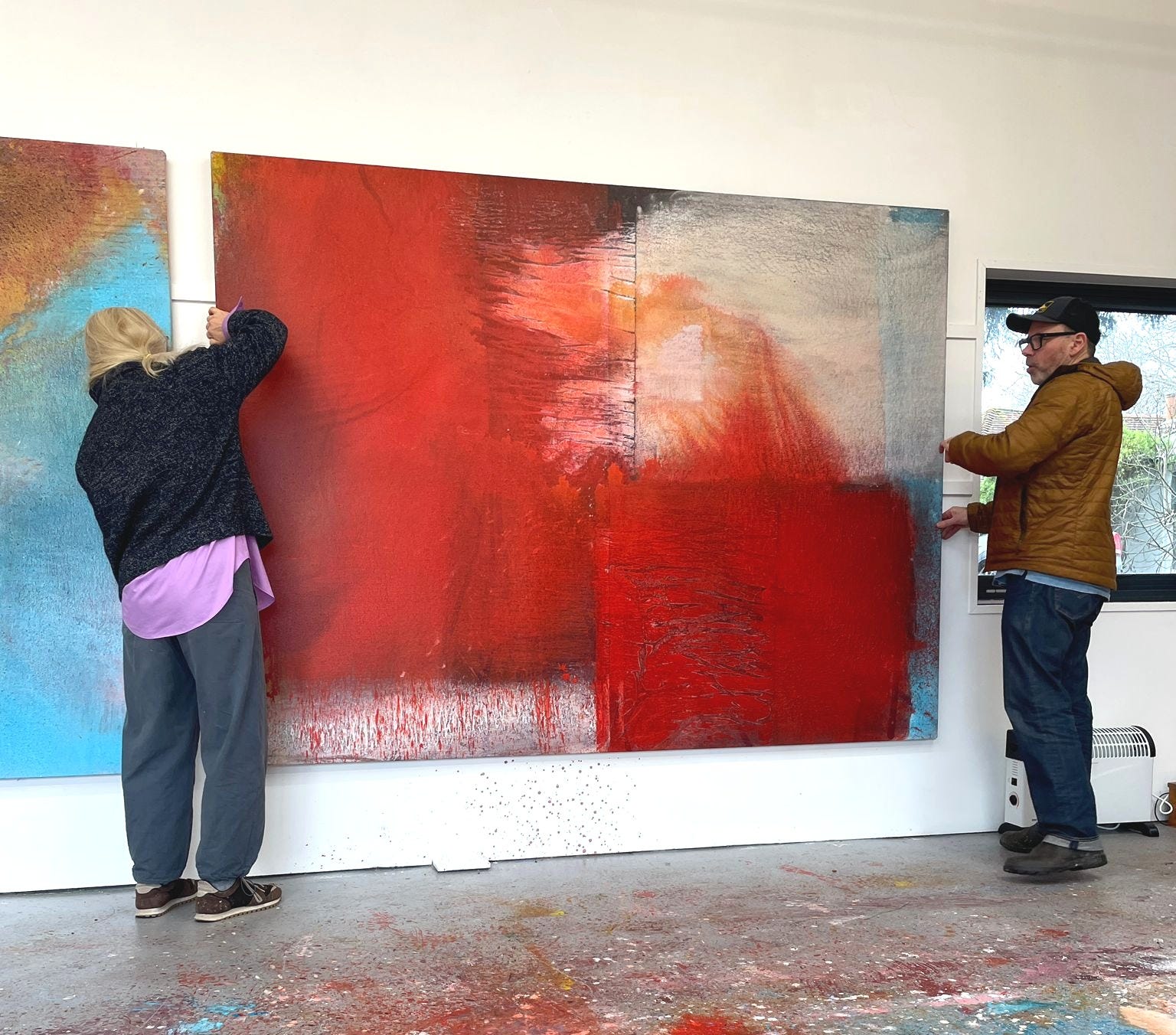
Paintings are not simply snapshots of the world made with old technology. They are constructed, choreographed, directed. They are inventions shaped through intuition, experience, sensibility, memory, rhythm, tension, symbol and form. In that sense, paintings are probably closer to dance or music than photography. They unfold through relationships, pressure, pacing, contrast and release.
A painting is not merely an image.
It is a way of thinking.
Part of the problem, I think, is the overwhelming proliferation of digital images. We see so much that we stop looking. The eye becomes trained to seek novelty rather than depth. We consume images rapidly rather than inhabit them slowly.
As a result, many artists are left trying to compete with the speed of images instead of developing a visual language capable of carrying meaning through structure, rhythm, atmosphere, pattern, contradiction and symbol.
But this takes time.
It requires discipline, deep looking, and a broad understanding of culture and history that can give specific images context and weight. There is no shortcut if what you want is work that feels genuinely alive – work that is formally inventive and emotionally resonant.
These are often the conversations artists have privately with friends and colleagues: why a painting works, why another collapses, why one image holds tension while another merely illustrates an idea.
And this goes far beyond politeness or surface reaction.
Beyond:
“I like that colour.”
“That’s a nice mark.”
The real conversation is an attempt to get closer to the life of the work itself – to understand what gives a painting force, coherence, vulnerability, presence.
To ask:
What is this work doing?
What does it know?
What kind of pressure is held inside it?
What allows it to move beyond the ego of the artist into something larger, stranger, and more universal?
As an artist, I crave these conversations.
I crave spaces where rigorous and meaningful discussion can give form to the solitude of the studio and resist the flattening tendencies of social media culture. Spaces where artists can think aloud without fear of sounding foolish or unfinished.
Because unfinished thinking is essential to the development of serious work.
I want the freedom to fail honestly in the presence of people sensitive to the ambitions and uncertainties of artistic life. I want conversations capable of holding both doubt and possibility without immediately reducing practice to career strategy or market logic.
Since when did artistic practice have to shape itself entirely around the demands of visibility, professionalism, and institutional approval?
There are many good people helping artists become more “professional”: teaching statement writing, applications, branding, networking, online visibility, and the pursuit of gallery representation.
Some of this can be useful.
But none of it is the centre of the problem.
Galleries do not fundamentally transform the difficulty of being an artist. Nor do artist statements create meaningful work.
Something much more important is at stake:
the work itself, and the conversations and communities capable of sustaining it.
That might sound obvious, but it is worth asking honestly:
Are you receiving the level of discourse your work actually needs in order to grow?
Or are you hoping that better presentation might compensate for unresolved questions within the work itself?
Too often, those with institutional authority – critics, academics, curators – lack the practical visual insight required to articulate what artists genuinely wrestle with in the studio.
And those with the deepest practical understanding frequently lack the confidence, language, or platforms to speak publicly.
But perhaps that awkwardness is necessary.
The new often sounds clumsy before it becomes clear.
Let me dispel a few myths.
Having a gallery does not solve the problem of money, meaning, or cultural value. Success does not end uncertainty. Finding “your thing” does not complete the process of becoming an artist.
An artistic identity is not a fixed achievement. It is an evolving relationship between experience, form, thought, intuition, community and time.
And community matters enormously.
Not audience.
Not metrics.
Community.
You do not need permission to make ambitious work. But encouragement, recognition, and thoughtful dialogue from people who understand the conditions of practice can be transformative.
Artists need spaces where unfinished thoughts can exist.
We need conversations capable of accommodating uncertainty, contradiction, experimentation and change. We need structures that support long-term development rather than constant performance.
In response to the conversations that have emerged through Substack, Instagram, mentoring, and years of dialogue around artistic practice, I’ve decided to begin something called Studio Conversations.
Studio Conversations will start with a small online gathering for artists interested in sustaining a serious practice.
It is not about becoming the “best” artist in the room. It is about developing the conditions in which your work, and your thinking, can deepen over time.
Across five weekly sessions we’ll discuss:
subject, theme, and motif
influence and provenance
process and resistance
artistic identity and context
meaning, continuity, and sustaining practice
The sessions will be a space for reflection, exchange, critical thinking, and serious engagement with the realities of making work over the long term.
The first cohort begins Monday 13 July 2026.
5 weekly Zoom sessions
90 minutes each
recordings and notes included
discussion space between sessions
More information and registration here:
This is exactly the things I ask about my own work. I think social media has caused many artists to look outward and perform rather than asking the harder internal questions about their work. I journal often as I paint to try and flesh out the threads running through it all. I’ve been trying to find people who want to look deeper than the surface. I did a “demo” for an audience a few months ago and decided to do it differently. I treated it as though I was in my studio painting and narrated the thoughts I was having as I worked. It gave them a glimpse of a working artist rather than a typical demo. They loved it. I had one older gentleman, a retired judge, tell me that he never appreciated abstract art but after what I did, it made so much more sense to him. That it was more than just random paint thrown around. Now he seeks me out when he comes to our resident artists studios to chat about art. People want to know the process, the thoughts behind things, the whys. It’s still magical to them but it also brings understanding and deeper appreciation.
"I want conversations capable of holding both doubt and possibility without immediately reducing practice to career strategy or market logic.
Since when did artistic practice have to shape itself entirely around the demands of visibility, professionalism, and institutional approval?"
Yes! Studio Conversations is a great idea, I hope it is very successful. If you ever do an afternoon one, rather than evenings, please let me know.