On Return
The return begins before the work returns.

I’ve been thinking about this recently after I received a message from Phoebe Smith, an Instagram follower, asking if I’d write something about returning to work.
She explained her context of being a graduate who had left art school to get a job and earn money. She was optimistic. Art school had informed her of the importance of creativity and how significant skills around lateral thinking are to making industry effective. Of course, reality hits, and the stiff inflexibility of many working environments can quickly stifle any ideas of creatively making change.
Graduates could try their hand at entering the hallowed halls of the art world, with commercial galleries, public spaces and arts charities promising to be the proper place for a student of creativity. Anyone who has ventured there will know the all too familiar story. It is, in the end, often as risk-averse as any other industry. It makes safe bets on sure things. Why? Because the system is not designed to accommodate that kind of risk. Creativity is too often a word used as a branding exercise to convince buyers of the pretence of authenticity.
Yet the question she asked wasn’t really about careers. It was about return.
How do we come back to the things that matter?
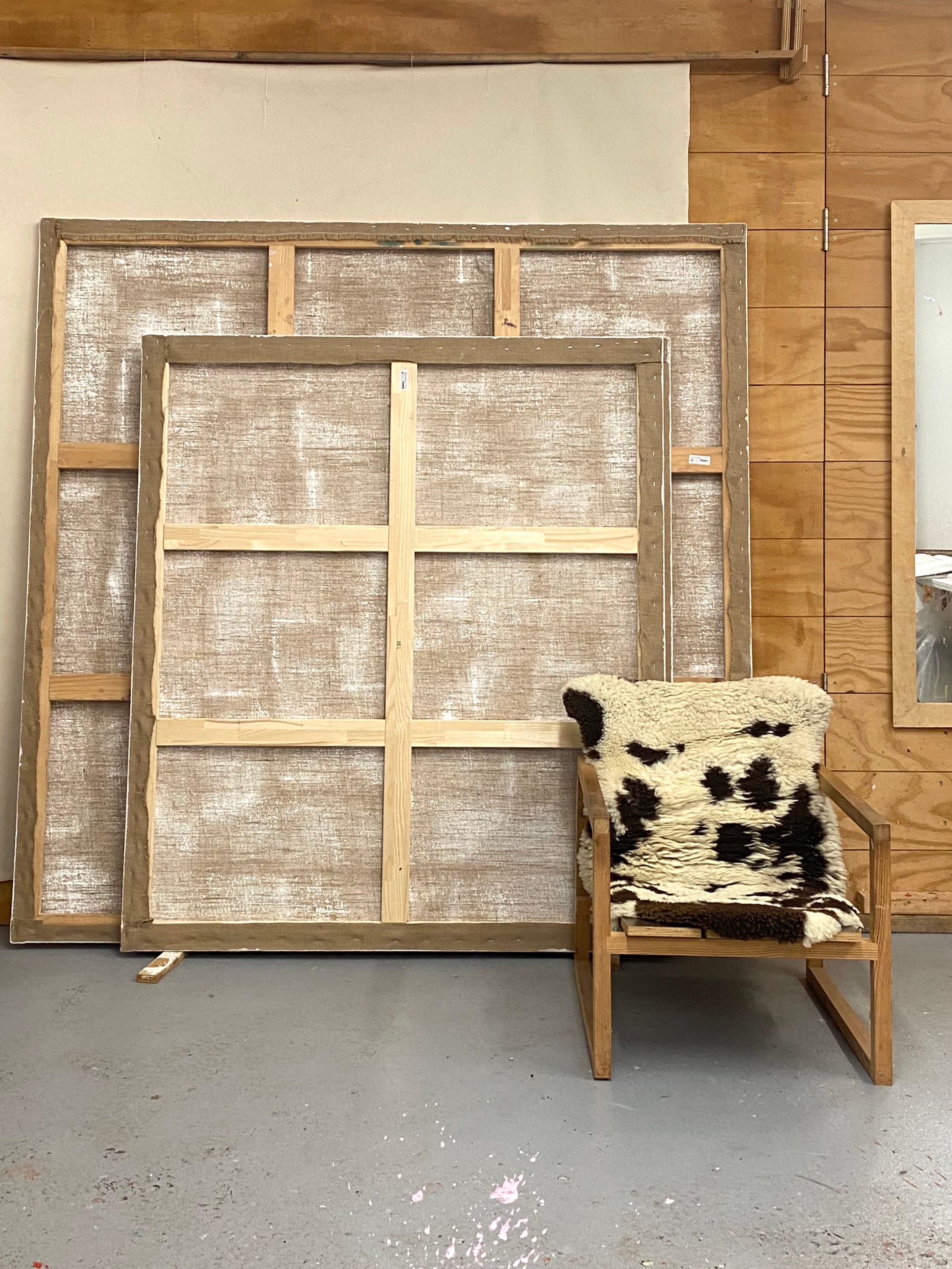
There are many kinds of return, arriving at wildly different moments in an artist’s life. The return after divorce, family commitments, ill health and redundancy. I’ve seen and experienced some of these myself. There is also the return after a successful exhibition, when the excitement of the opening night gives way to the quiet reality of an empty studio. The return to the studio is often in stark contrast to the extrinsic expectations of the world and our own ambitions.
But it is the return that matters.
The word itself has an interesting history. It comes from the Old French retourner, meaning “to turn back”. At its root is the Latin tornare, which referred to turning something on a lathe. Hidden inside the word is not the idea of going backwards, but of turning again.
I find that distinction helpful.
A return is not a recovery of some former version of ourselves. We do not step back into the same river. We return changed by experience, loss, success, disappointment and time. The studio is different because we are different.
Perhaps creativity itself is a series of returns. Returning to attention. Returning to curiosity. Returning to materials. Returning to questions. Returning to ourselves. This releases us from repetition to a kind of recurrence.
I graduated into an art world that, for most artists, held little or no promise. We didn’t have social media to tease us with dreams of stardom. There were relatively few galleries in London at that time, and getting any kind of attention was not something anyone expected. In effect, it was substantially easier to believe in the intrinsic value of what we do as artists. Maintaining curiosity and feeding our creative passion came from the work itself. The process was not on view to the world. A performative relationship to art was far from the norm.
In the 1990s, making money from art was difficult, mostly due to the lack of exposure. If an artist didn’t have gallery representation, how was the work to be seen and sold? Largely, this happened through artist-led initiatives, open studios and exhibitions in alternative spaces. Doing these were some of the most enjoyable exhibiting experiences I’ve ever had, mostly because they gave me an opportunity to speak directly to the community that had helped sustain the making of the work.
Today the challenge feels different.
We have more visibility than ever before and perhaps less attention; more opportunities for exposure and fewer opportunities for depth. We are encouraged to build audiences, establish brands, produce content and maintain relevance. The danger is that we begin to confuse visibility with value.
I try, where possible, not to post new work on social media until I have moved on and lost interest in it. Presenting something to the world whilst it is still in play — literally and metaphorically — can damage the relationship from which it emerges. It makes it worldly. It externalises its value as an object of commerce.
Its intrinsic value begins to wither.
More importantly, the implicit value of the work starts to suffocate beneath explanation and expectation. That, in the end, is the death of art itself. Art remains alive because it exceeds our understanding of it. The moment it becomes entirely known, it becomes something else.
All this has been on my mind over the last few years. I had almost a year away from the studio recovering from ill health, and my son is about to graduate from art school himself. I’m acutely aware of the challenges ahead. In many ways he is in a privileged position. He has the support of two parents who work in the arts. His mother is a successful public gallery director. Yet uncertainty, in a world that constantly parades wealth and fame as though they are the highest forms of human achievement, is a difficult context for anyone to emerge into.
In my work as a mentor, most people I meet would best be described as returners.
Often they are returning to sanity after a life spent in the so-called real world.
And I think this identifies what the problem really is.
When I was at art school, I loved it. For the first time in my life, education worked for me. I was in my element. I was given the freedom to play, experiment, question and openly discuss ideas and experiences around our shared creative lives.
Or perhaps I should say I was given permission.
Permission to be curious.
Permission to not know.
Permission to fail.
We often made a mess of this freedom. But the freedom to fail in public, amongst fellow strivers all failing too, was a reality I could believe in and one that could sustain me. It was when I left art school and entered the world outside that I realised how unreal that world often was, and how easily it accepted compromises in human dignity, that the work really began.
By most people’s standards, I had a successful early start to my life as an artist. Upon graduating, I had multiple galleries in London and New York. I paid my way through my MA at the Royal College of Art by selling paintings.
On the surface, it looked good. I had entered the art world and was apparently on a trajectory towards worldly success.
Yet I was growing increasingly suspicious of the motives of that world, especially the strange way it seemed to be counter to everything that was important to me. I wasn’t interested in being successful if success meant endlessly repeating myself and performing for the crowd.
What interested me was the work.
Research into creativity suggests something interesting. Psychologists have long observed what they call the incubation effect. The basic finding is that stepping away from a problem often improves our ability to solve it. Time away is not always an interruption to the creative process. Sometimes it is part of the process itself.
The mind continues working beneath the surface.
Connections form.
Fixations loosen.
Attention recovers.
In other words, absence is not necessarily the opposite of creativity.
Sometimes it is creativity preparing itself.
This feels true to my experience. Most returns do not begin with making. They begin much earlier.
They begin with a walk.
A notebook.
A conversation.
Tidying the studio.
Looking through old sketchbooks.
Standing in front of a canvas without knowing what to do.
The return begins before the work returns.
What we are returning to is not simply an activity called art. We are returning to a way of being in relationship with the world. A way of paying attention. A way of asking questions.
Perhaps this is why so many people find themselves returning to creativity after years away. The creative life offers something that modern life struggles to provide. Space for uncertainty. Space for play. Space for wonder. Space for meaning that cannot be measured in financial terms.
What many returners discover is that creativity was never really left behind. It was waiting patiently beneath the noise of everything else. The paintings may stop, but curiosity has a remarkable capacity for survival. Eventually it begins turning towards the light once more.
Which brings us back to the meaning of return itself.
To return is not to go backwards.
It is to turn again.
To turn again towards curiosity.
Towards uncertainty.
Towards play.
Towards meaning.
Towards whatever first called us into the work.
The return begins before the work returns.
There isn’t a sudden arrival, just a turning into the creative life again and again.
Matthew, your piece made me think about something I have experienced many times over the years.
People often imagine that an artist’s life is made up of exhibitions, awards, openings and recognition. Yet those moments are surprisingly brief. What remains is the daily practice of walking back into the studio and beginning again.
I have found that every interruption leaves its mark on us — illness, family responsibilities, success, disappointment, even simple passage of time. We do not come back unchanged. The work continues, but so do we.
Perhaps that is why painting has never felt like a destination to me. It feels more like a companion that patiently waits while life takes us elsewhere, and is still there when we are ready to continue the conversation.
Thank you for a thoughtful read.
Wonderful. Your writing is poetry for the studio. It has layers, and the writing is open enough to connect to the readers situation, regardless of position. Thank you