A Mused Studio
Do artists still have muses?

I first asked myself this question when I lived in the US in the mid-90s. I was working in a beautiful old electrical factory, the kind of space artists dream of. Vast windows, high ceilings, the sense that anything might be possible. And yet I often felt as though I was drinking water from a dripping tap.
The studio was generous, but I was not. I had space, but no inner structure. I needed guides. I needed something to help me stay with the work when inspiration was thin and the days felt longer than my belief in myself. I needed a muse or two.
The idea of the Muse originates in ancient Greek religion and mythology. The Muses were divine figures, daughters of Zeus and Mnemosyne (the goddess of memory), believed to inspire poetry, music, history, and the arts. They were originally linked to oral culture: the poet didn’t invent a song so much as receive it, as if it arrived from elsewhere.
Hesiod, writing in the 8th century BCE, begins The Theogony with the Muses as the source of his voice:
“They breathed into me a divine voice.”
— Hesiod
Over time, the Muse became a symbol of inspiration itself, a mysterious external force that speaks through the maker. Looking back, I think one of my problems was exactly that: the idea of an “external source.” I liked the romance of divine guidance, but in truth I had brought everything in-house. I was young, intelligent, ambitious, and full of the arrogance that comes from not yet knowing what you don’t know. I think I sensed this at the time, but I didn’t know where to look for help. I could, of course, have reached directly for the muses of old: Calliope for epic poetry, Erato for love poetry, Melpomene for tragedy. But their world felt opaque and distant. Their mythology was not lived in my daily life, and so the wisdom they carried couldn’t breathe in the studio. It remained decorative. So I did what many artists eventually do, whether consciously or not: I went searching for muses closer to home
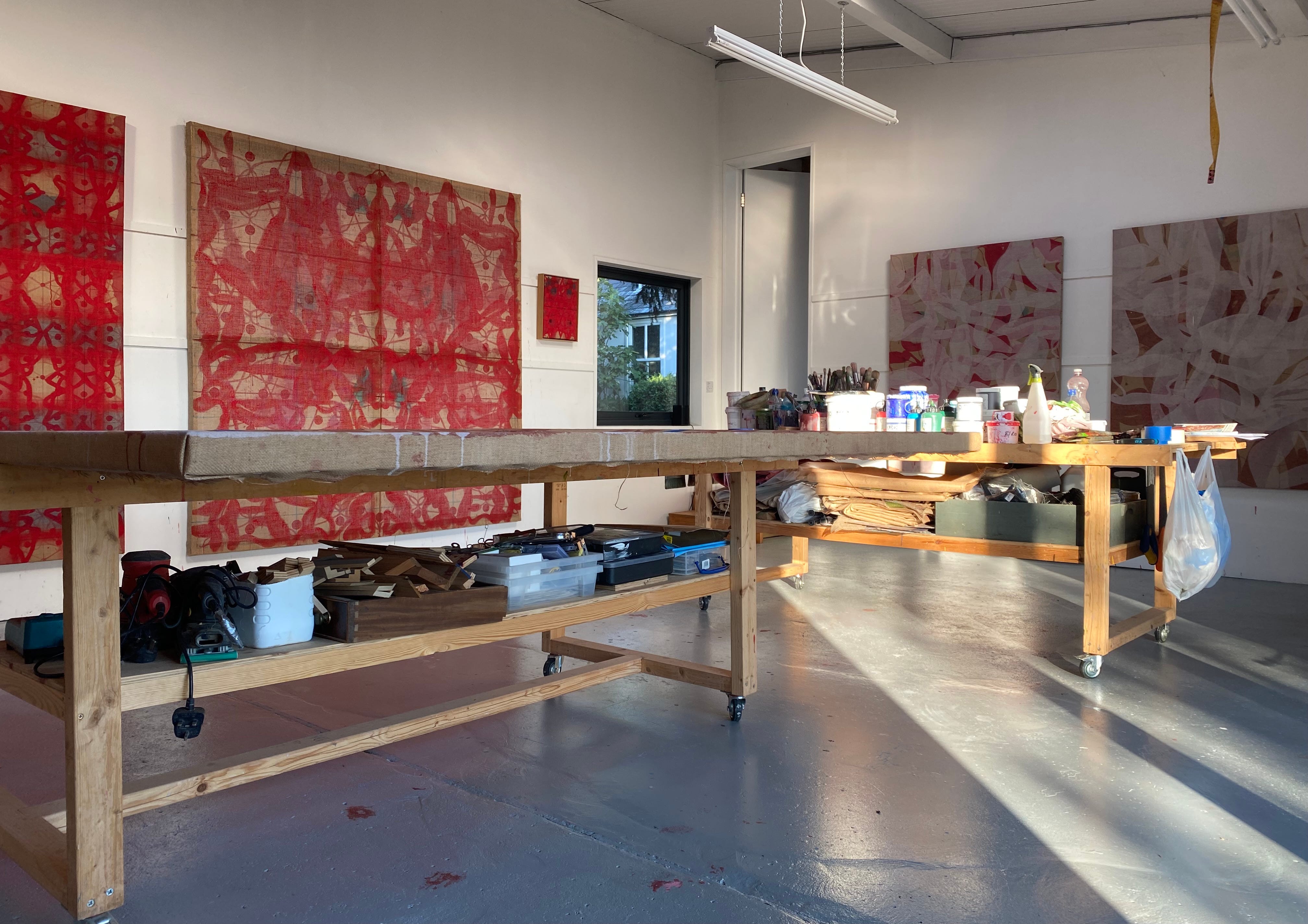
I had to find my own. And that meant a deep dive into my inner life, the parts of myself that could guide my creative spirit when certainty failed and inspiration withdrew. Over the following decades I met my muses one by one. Currently there are five: humility, honesty, hunger, humour, and hope. I call them my five H’s. I’ve met each one in turn over the years, so let me introduce them, and tell you a little about our relationship.
Humility
I first met humility sometime around 1993. I was at the Royal College of Art, doing an MA in Painting under Professor Paul Huxley. I was thrilled to be there. It had been my dream since childhood. I arrived full of ambition and an outsized ego, determined to make my mark. As always, I threw myself into the work wholeheartedly. But I was one of the younger students, having come straight from undergraduate training, and I felt my naivety immediately. Everyone seemed so smart, talented, articulate, and interesting. I felt ignorant and incompetent by comparison.
Humility arrived like a cold weather system. At first it made me withdraw socially. It doused me in self-doubt. It turned the studio into a daily ritual of embarrassment. It is, without question, a painful muse to meet. It is a tough taskmaster. But humility is also the beginning of real learning. It is the moment the ego loses its certainty, and something deeper becomes possible. Humility doesn’t say you are nothing.
It says: you are not finished. And in that, I found a sense of freedom.
Honesty
I’ve always believed that radical honesty is the route to doing anything well. We have to begin with a robust assessment of who and where we are. Without it, we build our lives on performance. As such, honesty felt like a muse I already knew - or at least, I thought I did.
Honesty is subtle. It is not the same as bluntness. It is not a performance of “authenticity.” It is the willingness to be in contact with reality, even when reality is inconvenient. Honesty is the courage to see what is true, even when it costs comfort, approval, or certainty. It requires self-awareness, humility, and the willingness to be changed by what you discover. In painting, and in life, honesty is complicated because truth is rarely simple. There are facts, yes. But there is also a deeper truth: the overlap between the objective and subjective, the implicit and the explicit, the intuitive and the rational. Truth is often relational. It happens between things. And that betweenness feels more spiritual than material.
Perhaps honesty is ultimately a form of connection: a seeing with eyes and heart wide open, without bias or defence. The painting always knows when I’m lying. It may not shout, but it withdraws.
Hunger
Hunger might seem like a strange muse. In a culture obsessed with satiety, it is almost always framed negatively. But for much of human history hunger was a natural state, and in many ways a healthy one. Hunger sharpens attention. It makes us alert. It reminds us we are alive. Satiety is useful, but it was never meant to be permanent. Comfort is not a good artistic strategy. So what does hunger have to do with inspiration? Everything.
Satiety produces satisfaction, and satisfaction can be a kind of creative death. The creative spirit needs challenge. It needs friction. It needs failure. It needs longing. Hunger keeps the work open. I don’t mean starvation, I mean the willingness to live with discomfort as part of the process. To accept that not knowing is fertile. To recognise that impatience is often a disguised desire for control.
Hunger creates patience. It trains awareness. It makes gratitude possible when the work finally feeds you. Hunger is the muse that keeps me returning.
Humour
If you haven’t already noticed, I’m quite a serious person. Humour came late for me. It’s not that I didn’t enjoy a laugh, but I was often suspicious of people who constantly needed others to laugh along with them. I wondered what they were avoiding.
Over time I realised that humour is not avoidance. It can be a form of spiritual intelligence. Humour oils the wheels of creativity. It allows failure to be true to itself. It interrupts the grim seriousness that artists so easily mistake for depth. It upsets the applecart of high-mindedness with a gentle reminder: I am not special. Or perhaps, more truthfully: we are all special, and none of us are exempt.
Humour often arrives in my studio as a small chuckle: the moment I realise the painting has dodged my best efforts. I’m trying to force it into obedience, and it refuses. If I’m humble enough, and honest enough, I stop fighting and begin listening. Humour is a robust sparring partner. It doesn’t want to humiliate me, but it will insist that I don’t take myself too seriously. The painting is always more clever than I am.
Hope
Hope is my most recent addition to the pantheon.
I’ve worked as a professional artist for thirty-five years. I’ve had many ups and downs. I’ve made mistakes and taken detours. I still often feel like a beginner. And that can be hard, especially when everyone else looks so sorted. Hope is what gives the other muses oxygen. It doesn’t offer certainty. It doesn’t guarantee success. It simply keeps the door open. It keeps the future alive.
Vaclav Havel wrote something that has stayed with me:
“Hope is not the conviction that something will turn out well,
but the certainty that something makes sense, regardless of how it turns out.”
— Václav Havel
That is the kind of hope the studio requires. It is endurance with meaning.
I’ve watched many of my contemporaries lose hope, and it’s understandable. Prolonged exposure to the art world can leave you feeling that everything is a performance: ego, narcissism, fashion, status, and a constant hunger to be seen. Hope doesn’t deny this. It simply refuses to let cynicism become the final word. Hope makes room for sincerity. It helps communities form around what is shared rather than what is sold. It takes me back to the beginning again: humility, honesty, a rumbling stomach, and a cheeky grin.
Hope is the muse that reminds me the work is still worth doing. Perhaps this is what a mused studio really is: not a place where divine inspiration arrives like lightning, but a place where we learn to meet ourselves more fully. To work with humility, honesty, hunger, humour, and hope is to practise becoming human.
And perhaps that is what the muses were always pointing towards: a way of living, and therefore a way of painting.
Really, really well written Matthew 🤩
So interesting and bang on the mark.
None, or all of us are special, I find that so liberating!